
STUTTGART (1931 - 1938) / Germany
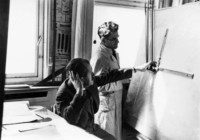
Founded in 1921, the Porsche design and development office, specialising in the construction and development of racing cars, is based at Kronenstraße 24 in the centre of Stuttgart.
Founded in 1921, the Porsche design and development office, specialising in the construction and development of racing cars, is based at Kronenstraße 24 in the centre of Stuttgart.
ZUFFENHAUSEN (1938 - present) / Germany
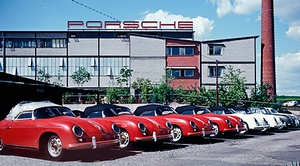
In June 1938 the company moved to a new complex of buildings in the Zuffenhausen district, about 15 minutes north of Stuttgart. There, in 1938, on Hitler’s orders, the first series of the Volkswagen Beetle was built, followed in 1939 by the Type 64, forerunner of all later Porsche sports cars. After the German defeat, Porsche had to move to Gmünd in Austria, where it built about 49 examples of the first 356 before returning to Stuttgart at the end of 1949.
As the Porsche factory in Zuffenhausen was then still occupied by the American army, Porsche first rented a production centre on the grounds of the nearby “Reutter” factory, before returning to Zuffenhausen, which soon proved too small for the success of the 356.
The buildings erected in 1950 as Porsche Plant 2 were completed in 1952. Plant 3 followed in 1960, and it also housed the sales and customer service departments.
Today the whole site comprises 7 departments: the body workshop, the paint workshop, vehicle assembly, interior finishing, engine assembly and the test benches. Porsche’s production models are built alongside the competition versions on the same assembly line.
Today almost 3000 employees work there to produce the 911, the Boxster and the Cayman, as well as all Porsche engines (except the diesels, which currently come from Audi).
The Porsche Museum opened its doors in 2009 on the same Zuffenhausen site and two years later welcomed its one millionth visitor.
Zuffenhausen factory · FLAT 69 video
WEISSACH (1971 - present) / Germany
This is Porsche’s research and development centre, the place where the future models are born. It also has its own test track and is 30 minutes from Zuffenhausen. 3800 people work there!

This is Porsche’s research and development centre, the place where the future models are born. It also has its own test track and is 30 minutes from Zuffenhausen. 3800 people work there!
UUSIKANPUNKI (1997 – 2011) / Finland
Porsche was unable to cope with the success of the Boxster and, for almost 15 years, outsourced a large part of Boxster and Cayman production to VALMET Automotive Inc, an independent car manufacturer. Up to May 2011, 227,890 vehicles were produced for Porsche (109,913 Boxster 986, 59,264 Boxster 987 and 59,413 Cayman). The collaboration continued until the end of 2011, and Valmet supplied Boxster and Cayman bodywork parts until September 2011.
From 2012, this supply comes from a VW factory in OSNABRÜCK, in northern Germany.
LEIPZIG (2002 – present) / Germany
In 2002, Porsche builds a second production centre in eastern Germany to manufacture the Cayenne (35,000 units/year). The factory’s surface area doubles in 2007 to produce the Panamera (25,000 units/year). The Carrera GT was also assembled there between 2003 and 2005. From 2012, Leipzig will also be the production site of the future CAJUN (CAyenne JUNior). 1000 employees work there on these two models. The factory has an asphalt and off-road test track.
In 2011, Leipzig still has no bodyshell production of its own; the Panamera and Cayenne bodyshells are subcontracted to VW. The Panamera bodyshells arrive painted and unassembled, whereas those of the Cayenne arrive pre-assembled (without chassis or mechanicals). Porsche, which worked in Weissach on the Cayenne, Touareg and Q7 project, subcontracts a large part of its production to VW at the Bratislava factory in Slovakia; the vehicles are delivered directly by rail to the Leipzig factory.
Leipzig factory · FLAT 69 video
In 2002, Porsche builds a second production centre in eastern Germany to manufacture the Cayenne (35,000 units/year). The factory’s surface area doubles in 2007 to produce the Panamera (25,000 units/year). The Carrera GT was also assembled there between 2003 and 2005. From 2012, Leipzig will also be the production site of the future CAJUN (CAyenne JUNior). 1000 employees work there on these two models. The factory has an asphalt and off-road test track.
In 2011, Leipzig still has no bodyshell production of its own; the Panamera and Cayenne bodyshells are subcontracted to VW. The Panamera bodyshells arrive painted and unassembled, whereas those of the Cayenne arrive pre-assembled (without chassis or mechanicals). Porsche, which worked in Weissach on the Cayenne, Touareg and Q7 project, subcontracts a large part of its production to VW at the Bratislava factory in Slovakia; the vehicles are delivered directly by rail to the Leipzig factory.
Leipzig factory · FLAT 69 video